Should you get it?
The clearest low-cost starting point in the four-tool Etsy dataset: $0/mo, paid plans from $5.99/mo, and explicit <20 reporting floors. Use its volume estimates directionally, not as forecasts.
- Current cost
- $0/mo · paid monthly from $5.99/mo
- What we checked
- Pricing + Etsy search estimates
Etsy sellers who want a low-commitment research plan and will compare keywords within one tool rather than mixing volume scales.
you need a sales forecast, verified workflow savings, or a volume number that can be compared directly with another tool's estimate.
What we checked
Still open: support quality, long-term time saved, outcome impact, connected-shop listing audits, rank tracking, and product-wide reliability remain outside the dated workflow record.
How we know this (and what we have not tested)
Prices checked
What it costs right now
These prices come from the vendor pages we checked. Price does not tell us how well a tool works.
| Product | Current price | Cadence | Plan limits | State |
|---|---|---|---|---|
| eRank | $0/mo; paid monthly from $5.99/mo; annual from $5.50/mo; $65.99 billed annually | Monthly and annual | 7 checked plan options | Price checked · 2026-07-14 |
We checked these prices against the vendor’s page. They are not a product-performance rating.
Check the live plan page and make sure its limits match your work.
Decision frame
Who should—and should not—consider eRank
The Free record allows five keyword lookups and five listing audits per day for one connected shop and 50 listings. That is enough to test a small, repeated research routine before choosing a paid tier.
Basic raises the recorded limits to 100 keyword lookups and 50 listing audits per day, with five competitors and 200 connected listings. Pro and Expert add materially larger allowances, so the decision should follow a documented workload rather than shop size alone.
Segment fit
Where eRank fits—and where it adds cost
eRank’s plan structure makes seller volume the useful dividing line. A shop that needs occasional keyword checks and a small number of listing audits can begin by testing the Free allowance against one real optimization cycle. Basic becomes structurally relevant when 100 daily keyword lookups and 50 daily audits cover the working set; Pro and Expert should be considered only when competitor tracking, connected-listing volume, or daily audit demand has been documented rather than guessed.
That makes eRank a candidate for Etsy operators with a repeated research-and-audit routine, not a generic purchase for every shop. A seller who already receives usable keyword and listing diagnostics elsewhere should count the duplicated steps before adding it. Skip it if the required tier is being chosen from shop size alone, if another tool already covers the same lookups, or if untested demand estimates would be treated as marketplace truth.
Feature analysis
A feature earns space only when it changes a decision
The verified plan record supports a progression from limited free keyword and listing checks to higher daily limits, competitor tracking, and more connected listings. Those are access facts, not proof that the interface saves time or that an estimate predicts demand.
A dated Basic-plan session observed keyword research, five-keyword bulk research, a public-shop lookup, and Trend Buzz. It also observed that ascending Etsy Competition sort surfaced many all-“Unknown” rows before usable rows, so filtering—not sorting—was needed for that task. Support quality, long-term time saved, outcome impact, connected-shop listing audits, and rank tracking remain open evidence dimensions.
Data quality
Outputs are compared, not treated as ground truth
eRank appears in the same-window 50-keyword capture used by the Divergence Report. Seventeen captured volume displays used an explicit <20 floor, which is more transparent than a false exact count but does not establish accuracy.
Across the shared capture, the median keyword’s highest displayed volume was 137x its lowest. eRank should therefore be used for directional comparison inside one tool, not as a direct forecast or a number that can be mixed with another provider’s scale.
We tested this ourselves
Basic-plan test — 2026-07-27
One 6.5-minute tested by us session on 2026-07-27; one seed keyword and selected distinguishing workflows.
- 01Keyword research completed
The seed query returned a usable result in approximately 8 seconds and the same credit returned 437 keyword ideas with per-row statistics and a KD column.
- 02Bulk, public-shop, and Trend Buzz workflows completed
A five-keyword bulk submission returned a 15-month trend chart; a public-shop lookup worked without a connected shop; Trend Buzz was available on Basic during the session.
- 03Observed Basic-plan quota behavior
The eRank session used 2 of 100 daily keyword searches. The observed public-shop lookup used its separate 200-per-day shop-lookup quota rather than keyword-search quota.
- 04Observed ideas-table friction
Ascending Etsy Competition sort surfaced many all-“Unknown” rows before usable rows, so low-competition discovery required filtering rather than sorting in this session.
Still open: support-quality testing, long-term time-saved measurement, outcome impact, connected-shop listing audits, rank tracking, and product-wide reliability remain outside this record.
What we saw on screen
What we saw while testing
These screenshots show one account and task on the date listed. They do not prove accuracy, sales, or overall product performance.
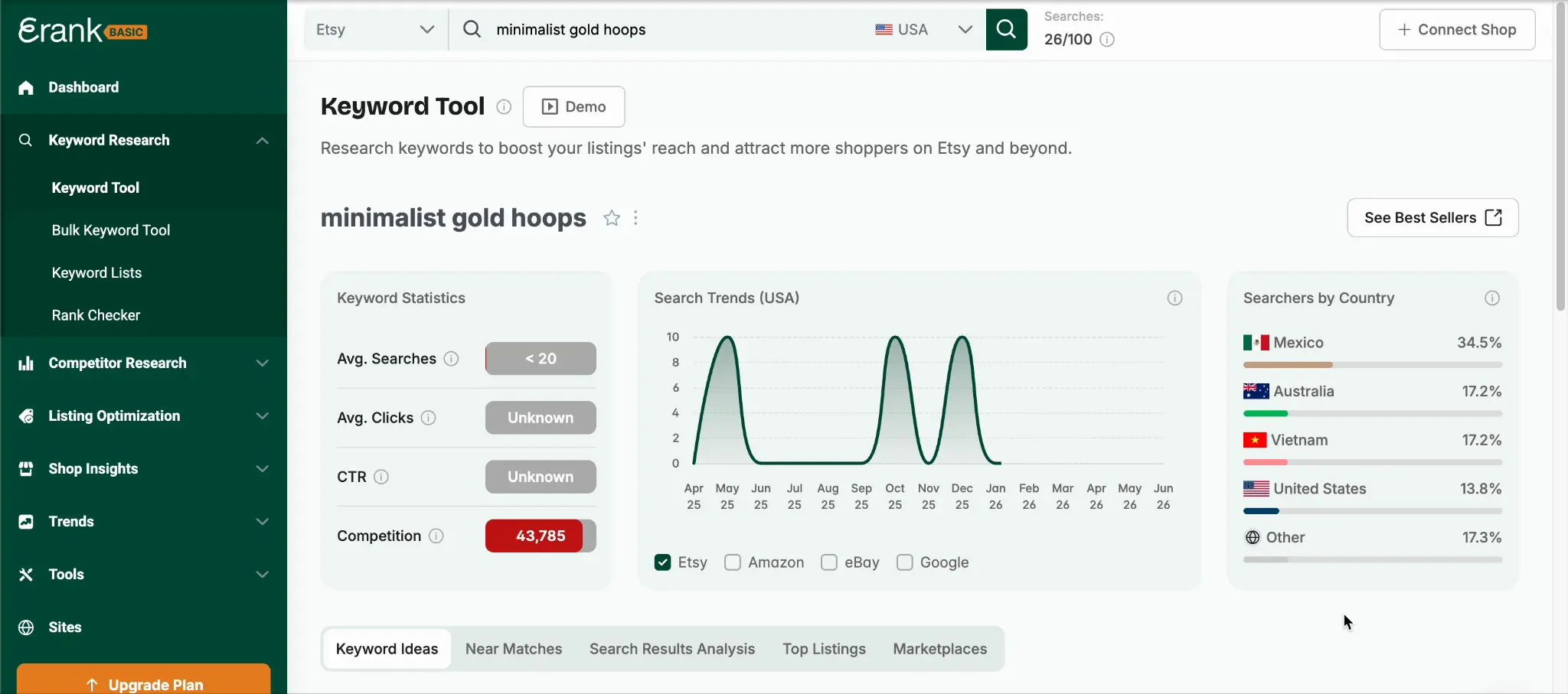
The captured eRank Keyword Tool screen shows a floor of “<20” for average searches and “Unknown” for CTR while still displaying 43,785 competition for “minimalist gold hoops.”
This is a dated observation of the interface’s reporting and disclosure behavior for one keyword in the listed session.
It does not establish metric accuracy, workflow speed, usability, support quality, seller outcomes, or a product recommendation.
Source Research Desk screen-recording frame supplied by the owner · · Basic plan · live account · Etsy / USA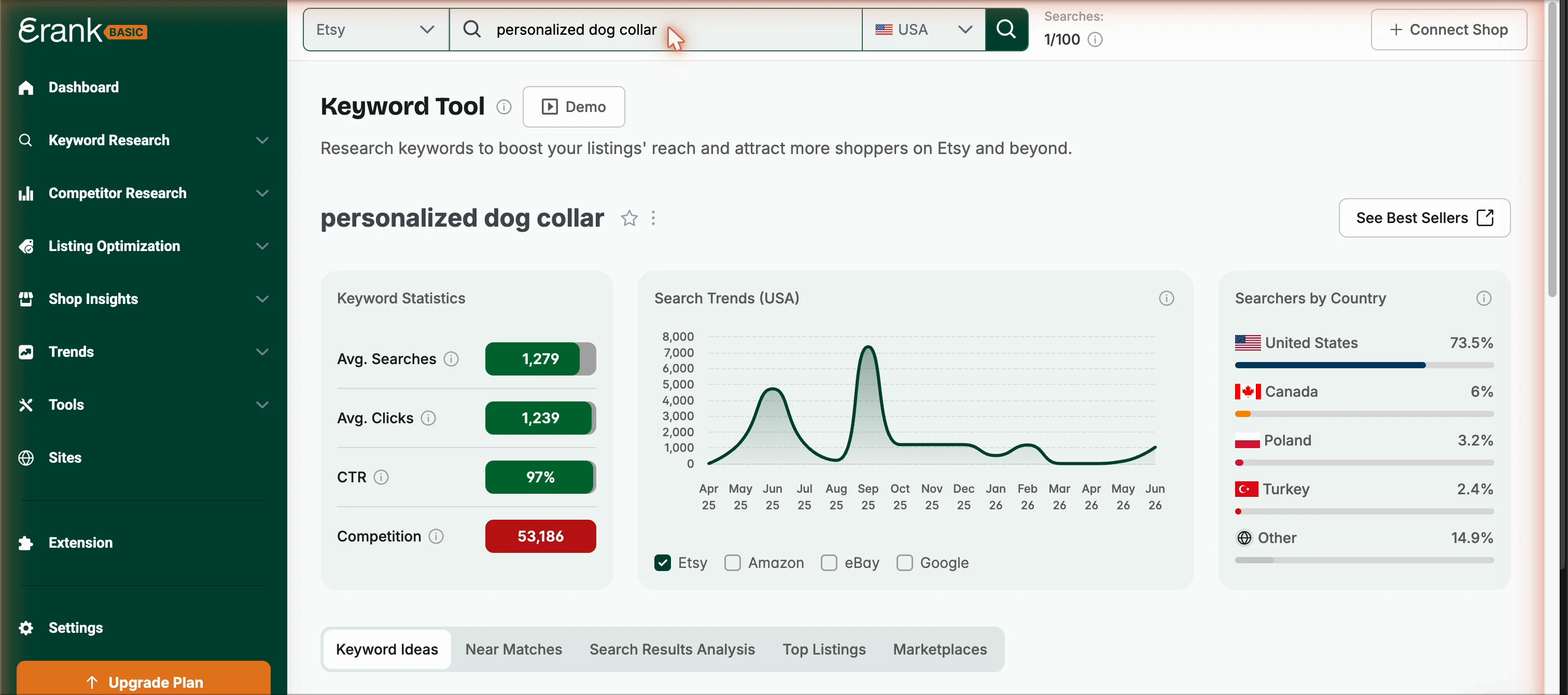
In the dated Basic-plan session, the query “personalized dog collar” returned 1,279 average searches, 1,239 clicks, 97% CTR, and 53,186 competition; the same credit returned 437 keyword ideas.
Keyword result and related-ideas view captured during the tested by us Basic-plan workflow test.
It records this dated interface state and task result only; it does not establish metric accuracy, product-wide reliability, support quality, long-term time saved, seller outcomes, or a product recommendation.
Source Research Desk browser-driven recording frame supplied by the owner · · Basic plan · live paid account · no Etsy shop connected · Etsy keyword research session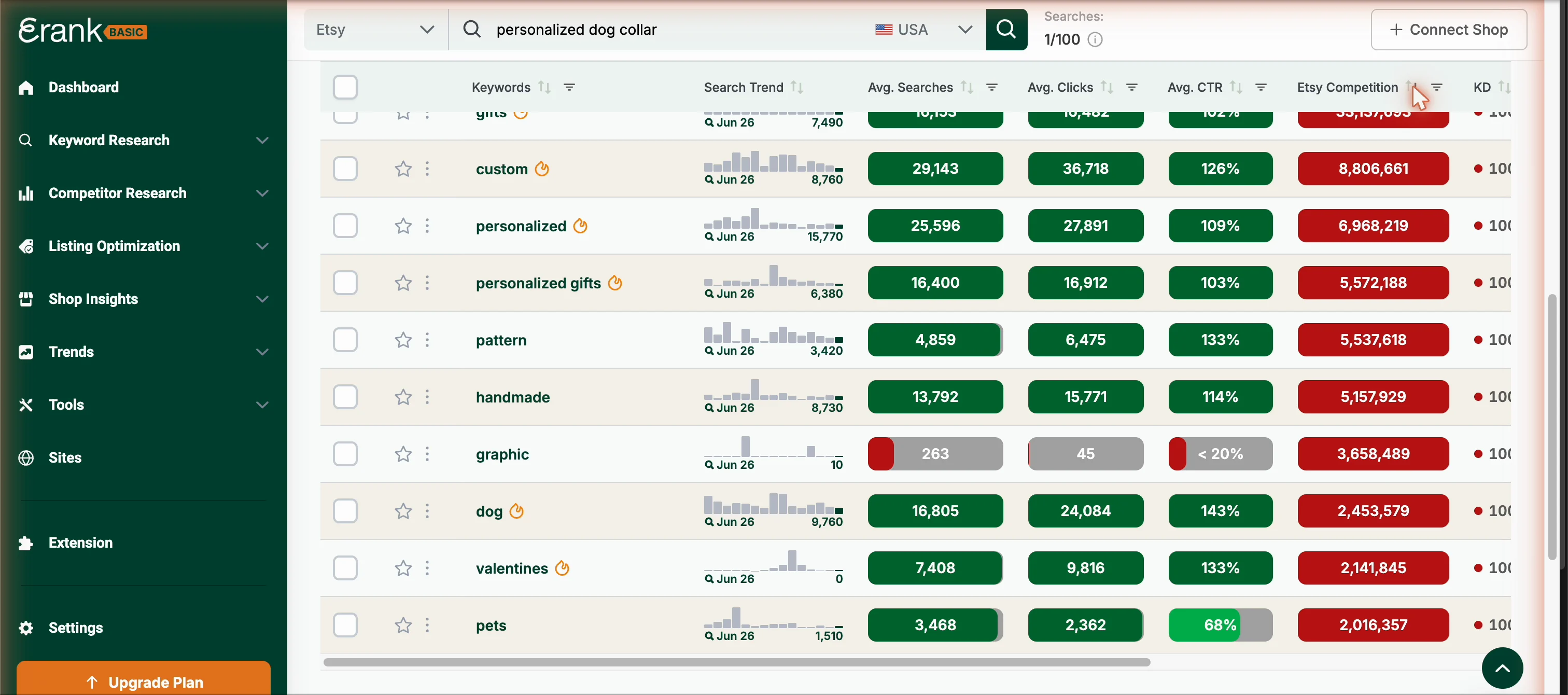
Sorting the dated ideas table by Etsy Competition ascending surfaced many all-“Unknown” rows before usable rows; the session required filtering rather than sorting to pursue low-competition ideas.
One observed sort/filter friction in the related-keyword table.
It records this dated interface state and task result only; it does not establish metric accuracy, product-wide reliability, support quality, long-term time saved, seller outcomes, or a product recommendation.
Source Research Desk browser-driven recording frame supplied by the owner · · Basic plan · live paid account · no Etsy shop connected · Etsy keyword research session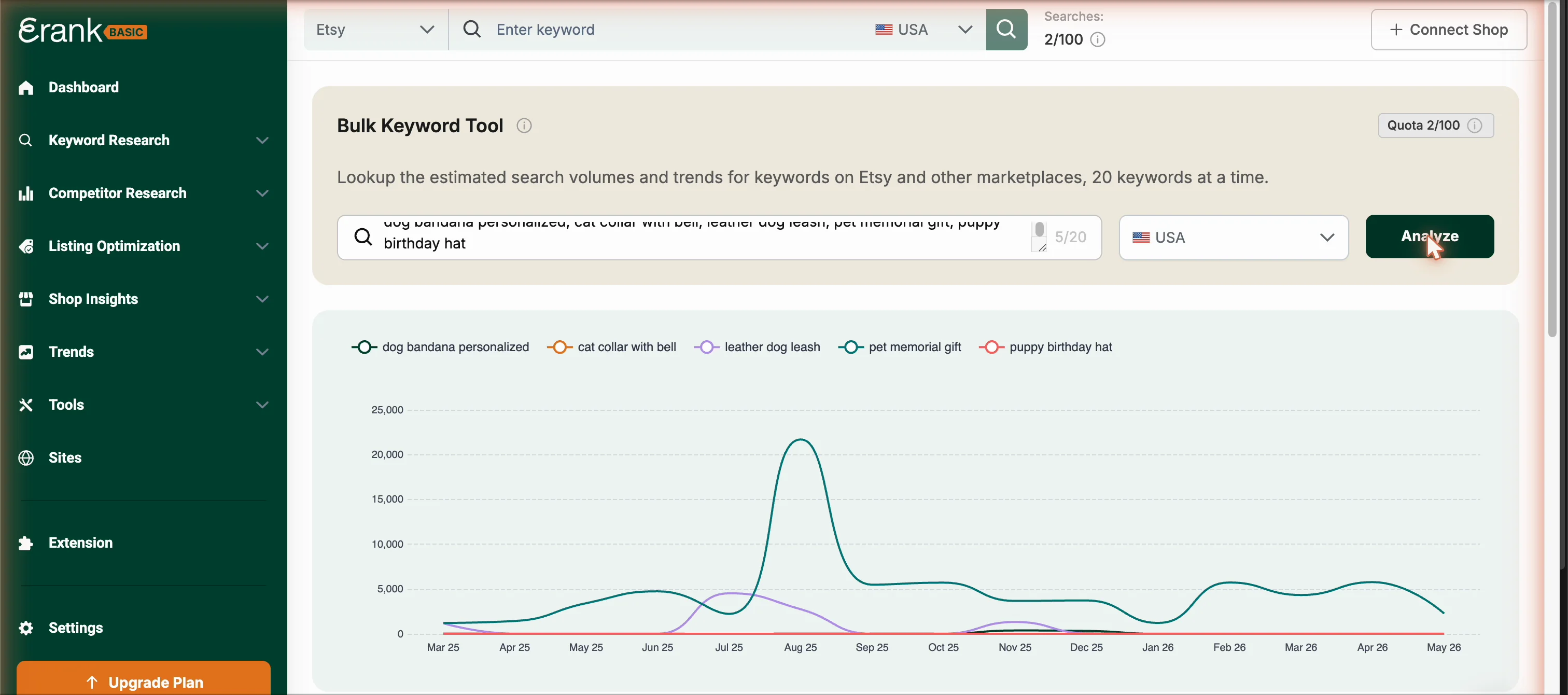
A five-keyword Basic-plan submission used one quota unit and displayed a 15-month trend chart alongside full values, a “<20” floor, and one all-“Unknown” row in the same batch.
One dated bulk-keyword output and quota observation.
It records this dated interface state and task result only; it does not establish metric accuracy, product-wide reliability, support quality, long-term time saved, seller outcomes, or a product recommendation.
Source Research Desk browser-driven recording frame supplied by the owner · · Basic plan · live paid account · no Etsy shop connected · Etsy keyword research session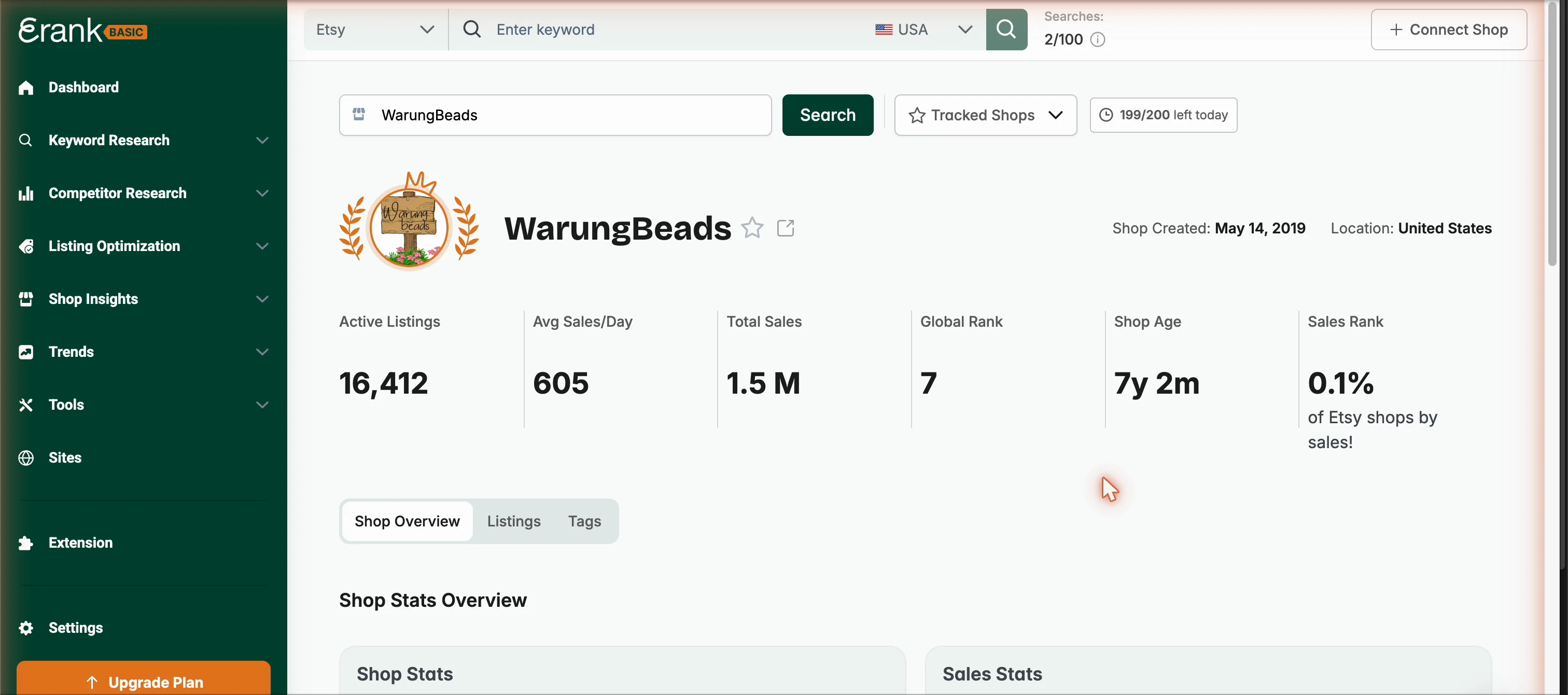
A public lookup of WarungBeads returned shop analytics plus Listings and Tags tabs with export; the session observed that Basic uses a separate 200-per-day shop-lookup quota rather than keyword-search quota.
One public-shop workflow observation, not a connected-shop listing-audit test.
It records this dated interface state and task result only; it does not establish metric accuracy, product-wide reliability, support quality, long-term time saved, seller outcomes, or a product recommendation.
Source Research Desk browser-driven recording frame supplied by the owner · · Basic plan · live paid account · no Etsy shop connected · Public Etsy shop lookup; no shop connectedBottom line
The clearest low-cost starting point in the four-tool Etsy dataset: $0/mo, paid plans from $5.99/mo, and explicit <20 reporting floors. Use its volume estimates directionally, not as forecasts.
Skip it if: you need a sales forecast, verified workflow savings, or a volume number that can be compared directly with another tool's estimate.